Art, Film, and Literature
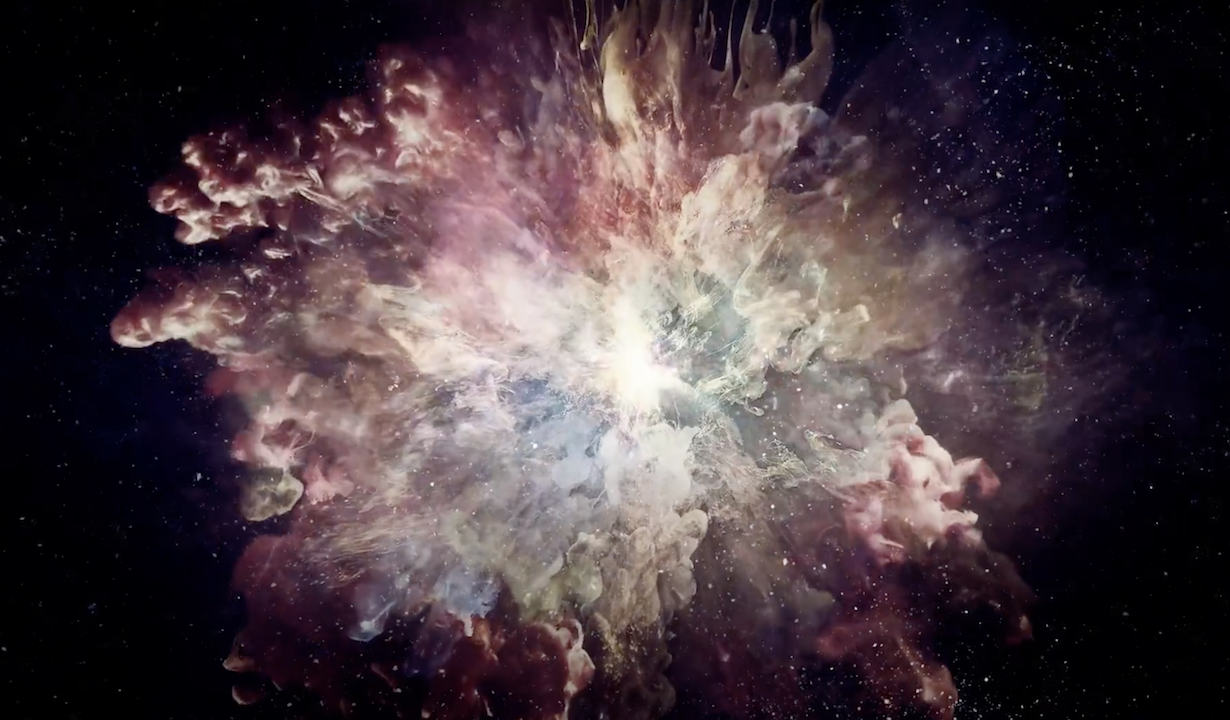
Image: “Novae”, Thomas Vanz, 2017
The University of Zürich (UZH) is home to researchers involved in space-related art, film, and literature.
Space Art Exhibitions
The Aesthetics of Wonder is a space art exhibition organized by UZH researchers and is composed of images related to astrophysics and Earth observation. The exhibition has been held at several locations over the past years and showcases the beauty of space research while highlighting the many departments at UZH that are involved in space research.
Download the catalouge of the The Aesthetics of Wonder exhibition here: ipz_broschüre_rz_digital (PDF, 37 MB)
Zurich Science Fiction Network
Researchers from UZH are active in the Zurich Science Fiction Network (ZSFN). The ZSFN has the mission of bringing together science fiction scholars and enthusiasts from German-speaking Switzerland for collective events and projects. It organizes events in Zurich and informs its members about science fiction-related happenings in all of German-speaking Switzerland.
Space in Film and Art
Space has long occupied a special place in film and the arts. Across history, visual representations of space have reflected not only what was known scientifically at a given time, but also what societies imagined, feared, or hoped for. Because outer space was largely inaccessible and untestable through direct experience, it became a powerful site for projection – shaped by mythological, religious, philosophical, and scientific ideas alike.
In the 21st century, marked by rapid advances in space science and technology, this imaginative dimension of space might appear to have lost its relevance. However, contemporary film and visual art show the opposite. Today, cinema and the arts play a central role in exploring how humans experience space beyond data and measurement – through aesthetics, emotion, speculation, and meaning-making.
Within the history of cinema and contemporary visual culture, space often functions as a symbolic and experiential landscape. It becomes a medium through which artists examine themes such as the desire for exploration, the promise of new worlds, alternative futures, metaphysical reflection, and the human search for meaning. These representations also respond to a fundamental aesthetic impulse: the encounter with vastness, beauty, and the sublime.
Cosmic Images: Astral Aesthetics in Film and Photography
As part of her postdoctoral project “Cosmic Images: Astral Aesthetics in Film and Photography” Jelena Rakin, PhD, investigates how cinematic and photographic representations of the cosmos carry cultural, theoretical, and aesthetic significance alongside scientific imagery. Her research examines how visual media interpret cosmic phenomena and translate them into narratives, symbols, and sensory experiences that shape public understanding of space.
Key thematic areas of the project include representations of the cosmos as a framework for:
- Metagalactic and spiritual journeys (e.g., Jordan Belson’s cosmic cinema)
- Visualization of travel beyond the solar system, influenced by astronomical imaging (e.g., “Hubble 3D”)
- Cosmogenesis at the intersection of scientific and religious cosmologies (e.g., “Voyage of Time”)
- The use of aesthetic elements to convey the enigmatic nature of cosmic existence (e.g., “2001: A Space Odyssey”)
- Ethical questions of exo-ecology and environmental responsibility beyond Earth (e.g., “Silent Running”)
- Terraforming and planetary engineering (e.g., “The Martian”)
- Space as a cosmic archive of time, memory, and the past (e.g., “Interstellar”)
Original Website: https://www.film.uzh.ch/de/team/mitarbeitende/postdocs/rakin/research.html
Point of Contact: Jelena Rakin, Dr. phil.
Excerpts of Jelena Rakin's research:
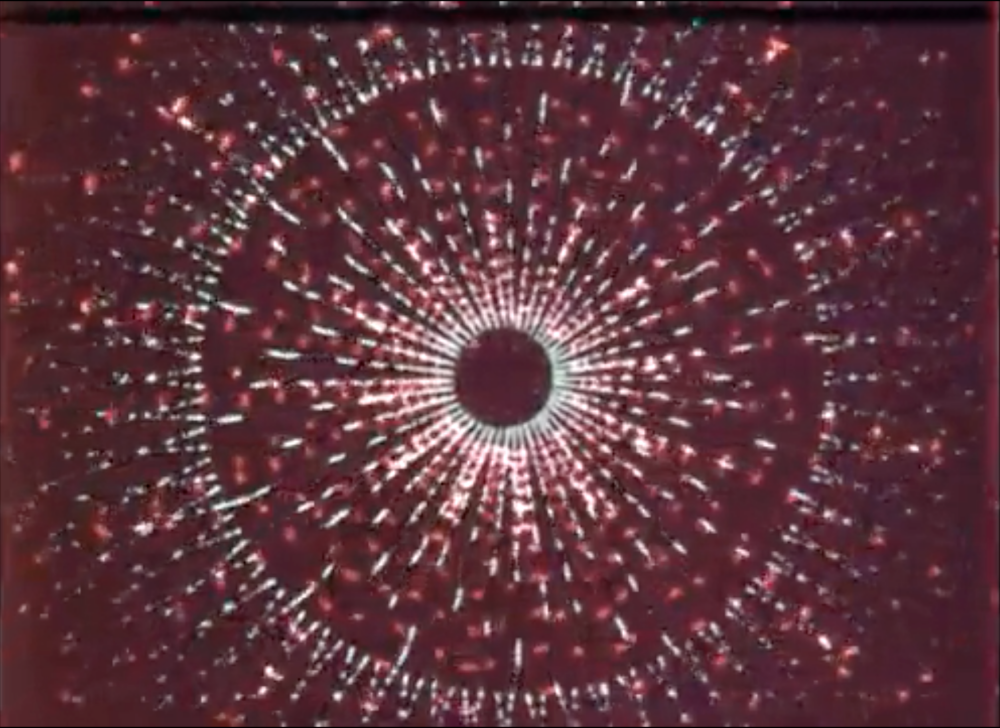
“Allures” (Jordan Belson, 1961, USA): Cosmic imagery between metagalactic speculation and spiritual experience
Jordan Belson’s avant-garde filmmaking is driven by an exchange between inner, cosmic consciousness and the phenomenological understanding of the cosmos as physical space. His films move fluidly between these domains, using abstraction to dissolve fixed scales of reference. As a result, individual shots can suggest both the macrocosm and the interior mesocosm, the empirically known and the speculative or imagined. In what is often described as his “cosmic cinema,” Belson draws on film’s unique ability make to perceptible phenomena that normally lie beyond human sensory experience. The reproduced still from “Allures” (Jordan Belson, 1961) is referenced as visual evidence of Belson’s use of spherical forms as a powerful archetype, through which ancient cosmological imagery is connected to modern representations of the universe.
“Voyage of Time” (Terrence Malick, 2016, USA): Cosmogenesis at the intersection of scientific and religious cosmologie
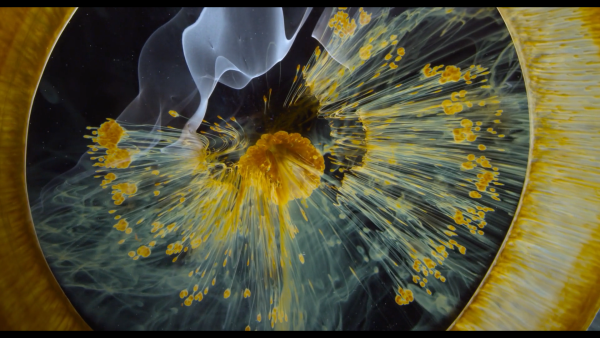
Cinema’s ability to visualize physically inaccessible realms through special effects and animation has long been associated with popular science-fiction narratives. At the same time, cinematic technologies have enabled more experimental aesthetic approaches to explorations of cosmic origins and connections. In “The Tree of Life” and “Voyage of Time”, director Terrence Malick brings together different cosmological narratives by visually reimagining scientific models of cosmic evolution, including the Big Bang, alongside motifs drawn from Christian creation narratives. Rather than illustrating either framework alone, the films construct a distinctly cinematic cosmology that operates through the aesthetics of awe, wonder, and the sublime. The reproduced still from “Voyage of Time” is referenced as visual evidence of the film’s cinematic synthesis of scientific cosmogenesis and religious creation narratives, using abstract, experiential imagery to render cosmic processes beyond direct human perception.
Organic Universe and Cosmic Biospheres
The films “Silent Running” (Douglas Trumbull, 1972, USA) and “The Martian” (Ridley Scott, 2015, UK) engage with ideas rooted in cosmological ideologies of human dominion over nature, shaped by narratives of technological progress and mastery. At the same time, both films reflect on the consequences of these ideologies, presenting space as a site for renewal and new beginnings. Together, they testify to the enduring cultural relevance of a central question driving both scientific research and commercial space exploration: the possibility of life beyond Earth. While “Silent Running” foregrounds the concept of the biosphere as a self-contained, fragile ecological system, “The Martian” employs imagery that evokes acts of creation, framing the emergence and sustenance of life in quasi-mythical terms.
The reproduced still from “Silent Running” (Douglas Trumbull, 1972) is referenced as visual evidence of the film’s biosphere concept, depicting an artificial, enclosed ecosystem that reflects contemporary scientific and ecological understandings of life-support systems.
The reproduced still from “The Martian” (Ridley Scott, 2015) is cited as visual evidence of the film’s use of creation imagery, in which the cultivation of life on a hostile planet is framed through visual tropes associated with origin and genesis.

