JWST Discovery Deepens Mystery of Massive Galaxies in the Early Universe
New observations from the James Webb Space Telescope (JWST) suggest that some of the most massive galaxies in the early Universe may be significantly more massive than previously thought. An international research team, including UZH astrophysicist Prof. Dr. Robert Feldmann, has found evidence that these distant galaxies contain a much larger fraction of small, low-mass stars than expected. The results have been published in Nature Astronomy.
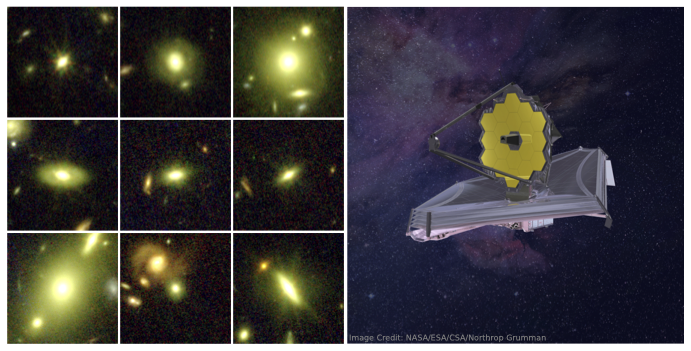
Hidden stars suggest that distant galaxies are much more massive than they appear
New observations from the James Webb Space Telescope (JWST) suggest that some of the most massive galaxies in the early Universe may be significantly more massive than previously thought. An international research team led by researchers from Leiden University, and including UZH astrophysicist Prof. Dr. Robert Feldmann, has found evidence that these distant galaxies contain a much larger fraction of small, low-mass stars than expected.
The researchers studied nine massive, mature galaxies using exceptionally deep JWST spectra combined with previous observations from the Very Large Telescope. This allowed them to determine the proportions of faint, low-mass stars and much brighter giant stars in such distant galaxies. Because low-mass stars contribute relatively little light despite accounting for substantial mass, previous estimates may have underestimated the total stellar mass of these galaxies.
“If a galaxy were a city, the brightest stars would be the skyscrapers that immediately catch your eye from afar,” says lead author Chloe Cheng (Leiden University), who earned her PhD in June based in part on this research. “A far more numerous population of low-mass stars is concealed by those rare, bright stars, like houses hidden between skyscrapers.” In one particularly striking case, a galaxy that formed less than 1.5 billion years after the Big Bang may be up to four times more massive than previously estimated.
"Until recently, measurements like these were simply impossible," says co-author Martje Slob (Leiden University). "We needed not only a telescope capable of magnifying very distant galaxies, but also spectra of exceptional quality and new analysis techniques to reliably detect the subtle signatures of faint, low-mass stars hidden within these cosmic titans."
The discovery adds to one of the major puzzles emerging from JWST observations of the early Universe. Since its launch, JWST has revealed numerous luminous and apparently massive galaxies at unexpectedly early cosmic times, challenging existing models of how rapidly galaxies could form and grow.
“Galaxy formation simulations already struggle to explain such massive galaxies so early in the Universe,” says co-author Feldmann (UZH). “The higher stellar masses implied by these new results increase this tension even further.”
For Feldmann, a theorist studying the formation and evolution of galaxies, the direction in which the new results point is particularly interesting. Several proposed explanations for the surprisingly massive galaxies discovered by JWST have suggested that their stellar masses might have been overestimated, for example because of contributions from active galactic nuclei (AGN) or bursty star formation histories.
“This study points instead in the opposite direction,” Feldmann explains. “The galaxy masses could actually be even higher, as these galaxies may harbor an unusually large fraction of low-mass stars. To reach their high stellar masses, these galaxies would have had to grow even more rapidly than predicted by most current models.”
The implications could extend to one of the fundamental assumptions used in modelling galaxy formation: the stellar initial mass function, which describes the distribution of stellar masses when a population of stars forms. “Future galaxy formation simulations may need to explain and account for variations in the stellar initial mass function under the extreme conditions of the early Universe,” says Feldmann.
The findings therefore not only revise estimates of how much stellar mass may be hidden in distant galaxies, but also raise new questions about how galaxies and their stellar populations formed during the first billion years of cosmic history.
The results have been published in Nature Astronomy.
Link to the publication: https://www.nature.com/articles/s41550-026-02932-4