JWST UNCOVER Collaboration to Receive 2027 Berkeley Prize
The JWST UNCOVER collaboration will receive the 2027 Lancelot M. Berkeley–New York Community Trust Prize for its work on the early Universe. UZH is part of the international collaboration through astrophysicist Prof. Dr. Robert Feldmann, who contributes a theoretical perspective to the interpretation of its findings and their comparison with galaxy formation models.
The JWST UNCOVER collaboration will receive the 2027 Lancelot M. Berkeley–New York Community Trust Prize for Meritorious Work in Astronomy. Awarded annually since 2011 by the American Astronomical Society (AAS) and supported by a grant from The New York Community Trust, the Berkeley prize includes a monetary award and an invitation to give the closing plenary lecture at the AAS winter meeting. The 249th AAS meeting will be held in Salt Lake City, Utah, from 10 to 14 January 2027.
The launch of the James Webb Space Telescope (JWST) has opened the door to a spectacular range of observations that were previously out of reach. UNCOVER — which stands for Ultradeep NIRSpec and NIRCam Observations before the Epoch of Reionization — is a Cycle 1 JWST Treasury program that conducted ultradeep imaging and spectroscopy of and around Abell 2744, a massive group of galaxies also known as “Pandora's Cluster.” The large mass of this cluster causes it to act as a powerful magnifying glass, bending the light from faraway background galaxies. Lengthy dedicated imaging of this gravitational lens and deep spectroscopy of JWST-identified sources has enabled the UNCOVER project team to identify and characterize distant galaxies from some of the earliest stages of our universe.
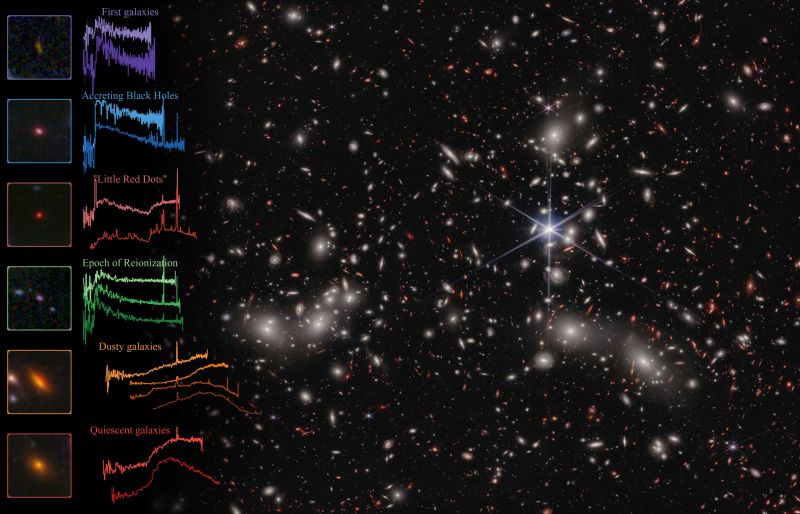
The primary science goals of the UNCOVER program are to constrain the physical properties of the first galaxies that formed in the universe; to explore how and when galaxies irradiated their environment and reionized the surrounding neutral gas; to discover dust-obscured galaxies out to a high redshift to probe star formation early in the universe; and to build a fuller picture of star formation quenching in galaxies over cosmic time.
The University of Zurich brings a theoretical perspective to the UNCOVER collaboration through Prof. Dr. Robert Feldmann, who contributes to the scientific interpretation, comparisons with models, and discussion of the emerging results. According to Feldmann, a particularly exciting aspect of UNCOVER is that it is providing a much more detailed view of the early Universe than ever before, and in doing so is challenging our understanding of how the first generations of galaxies and black holes evolved.
According to the prize citation, the UNCOVER collaboration is being honored with the 2027 Berkeley prize for “combining the power of telescopes and gravitational lenses to reveal the contents of the distant universe. Through spectroscopic studies, the team has discovered galaxies at cosmic dawn, including large populations of luminous galaxies and supermassive black holes in the early universe.”
Each year the three AAS Vice Presidents, in consultation with the Editor in Chief of the AAS journals, select the Berkeley prize winner for meritorious research published within the preceding 12 months. This year’s prize recognizes the UNCOVER team for three recent articles published in The Astrophysical Journal. The first and the second present an overview of the UNCOVER project, summarize its science goals, and characterize the initial imaging and final spectroscopy from the project. The third introduces a key result from the project: evidence that the population of faint, compact “little red dots” seen by JWST in the early universe is dominated by reddened, actively accreting black holes rather than simply dusty star-forming galaxies. The team showed that these reddened active galactic nuclei are far more numerous at high redshifts than previously recognized.
“UNCOVER has fundamentally expanded our view of the early universe, revealing a population of distant galaxies and growing black holes that was largely hidden from previous observations,” says AAS Senior Vice President Ted Bergin. “Its discoveries challenge our understanding of how the cosmos took shape while setting a powerful example of how large-scale collaboration can advance astronomy.”
The UNCOVER team consists of more than 50 people located across the globe. The Berkeley prize will be accepted on behalf of the collaboration by Ivo Labbé (Swinburne University of Technology) who, along with Rachel Bezanson (University of Pittsburgh), is the co-PI of UNCOVER. Labbé will give the prize lecture on Thursday afternoon, 14 January 2027, at the Salt Palace Convention Center in Salt Lake City, Utah.
Contact:
Dr. Susanna Kohler
AAS Press Officer
+1 202-328-2010 x127
susanna.kohler@aas.org
Dr. Ted Bergin
AAS Senior Vice President, University of Michigan
Edwin.BerginJr@aas.org
Image:
Pandora's Cluster, as imaged by the JWST UNCOVER program. The JWST UNCOVER team, which consists of more than 50 people located across the globe, will receive the 2027 Lancelot M. Berkeley–New York Community Trust Prize for Meritorious Work in Astronomy. The prize lecture will be given by Ivo Labbé on behalf of the collaboration at the 249th meeting of the American Astronomical Society, to be held in Salt Lake City, Utah, 10–14 January 2027. Credit: NASA, ESA, CSA, Ivo Labbé (Swinburne), Rachel Bezanson (University of Pittsburgh), Sedona Price (STScI); Image Processing: Alyssa Pagan (STScI)
https://aas.org/sites/default/files/inline-images/UNCOVER_objects.png
The New York Community Trust (The Trust) is the community foundation for New York City, Westchester, and Long Island. One of the oldest and largest community foundations in the United States, its mission is to foster and engage in enduring and innovative philanthropy. Since 1924, The Trust has brought together the local knowledge and diverse expertise of its team and nonprofit and philanthropic partners to support thriving and equitable communities and help donors champion the causes they love. The Berkeley Prize is funded through a grant from The Trust from a fund that carries out the legacy of Lancelot M. Berkeley, a New York Lawyer and astronomy enthusiast who died in 1945. In his will, he instructed his estate be used to support “through an annual award, highly meritorious work in advancing the science of astronomy.” The Trust is also a regional philanthropic leader. It established the first donor-advised fund in 1931 and works at the forefront of critical causes, including education, health care, racial and gender equity, immigrant services, affordable housing, and LGBTQ+ rights.
The American Astronomical Society (AAS), established in 1899, is a major international organization of professional astronomers, astronomy educators, and amateur astronomers. Its membership of approximately 9,000 also includes physicists, geologists, engineers, and others whose interests lie within the broad spectrum of subjects now comprising the astronomical sciences. The mission of the AAS is to enhance and share humanity’s scientific understanding of the universe as a diverse and inclusive astronomical community, which it achieves through publishing, meetings, science advocacy, education and outreach, and training and professional development.
Links:
Main press release: https://aas.org/press/jwst-uncover-collaboration-receive-2027-berkeley-prize
Social Media: Bluesky, Facebook,Instagram, LinkedIn